



Lovnica Monastery





Description
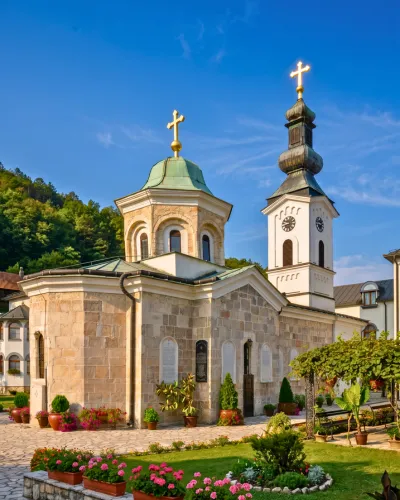
Lovnica Monastery is a women's monastery of the Serbian Orthodox Church, located at the spring of the Lovnica stream, two kilometers from Šekovići in Republika Srpska. According to tradition, it was founded by King Dragutin Nemanjić, who built the monastery at the place where he hunted and was captivated by its beauty. The Church of Saint George was built in the 1560s or 1570s, and the oldest preserved written mention dates from 1301.
The interior is adorned with one of the most valuable fresco cycles from the Ottoman period in Bosnia and Herzegovina — the work of the famous Peć monk Longin, who also created the iconostasis in 1577–1578. The throne icon of the Virgin Mary is considered one of the most beautiful icons of the Mother of God in the Serbian Church. The church is a single-nave building of rough stone with a five-sided apse, architecturally related to the churches in Gomionica, Rmanj, Krka and Krupa. It has been declared a national monument of BiH.
Longin's frescoes
Monk Longin was considered the best Serbian fresco painter of his time — and it is precisely in Lovnica that his finest frescoes have been preserved, created at the height of his artistic maturity. Art historians point out that in Lovnica the drawing almost completely dissolved into color, and the forms acquired extraordinary softness.
Longin did not complete the fresco painting; the work was taken over by four masters whose work differs in quality, as they themselves testify in the inscription above the door: they asked the brothers not to curse them, because they painted "in great fear of the Turks and the softa." This authentic 16th-century sentence is a unique cultural document about the conditions in which some of the most valuable frescoes in Bosnia and Herzegovina were created.
Legend and surroundings
Lovnica takes its name from the stream that springs right next to the monastery courtyard, and there are two traditions about its origin. According to one, King Dragutin Nemanjić built the monastery at the place where he hunted — "hunting hunted" — and was captivated by it. According to the other, the church moved itself to the spring, which was first noticed by hunters who then brought the builder.
Around the monastery lie necropolises with stećci decorated with vine motifs, and the area around it was also an important route from Spreča to Sarajevo during the Ottoman period. These layers — prehistory, the Middle Ages, the Ottoman period, Orthodox revival — make Lovnica one of the most layered monastic sites in northeastern Bosnia.